Kassel, Germany - the practical examples of Customer delight in the real world!
It's not hard to imagine going to a restaurant on a romantic tete-a-tete with your partner on your birthday. But what is definitely astonishing is the emotional intelligence behind a manager who while monitoring on staff interaction picks-up on this fact to create an opportunity to surprise & delight!
The outcome of the female connection with emotional intelligence and feeling? I was presented with a candle lit flower arrangement and a "Plum Chiew" alcoholic beverage. It was an amazing & genuine experience, you could see it in the eyes of the female manager & owner of the Chinese restaurant, who happened to be the mother of the waiter who was entertaining us with idle chat for the evening in Kassel, Germany. It's one of those rare & genuine service experience encounters that you will treasure forever!...This was true textbook "customer delight"...why aren't more service experiences engineered like this...?...It got me thinking!
...If some forward thinking, forward looking restauranteur embraced customer delight on a regular basis and mixed it up with best practice from around the world, surely they would kick so much butt in the restaurant trade in the UK!
Tips discovered while reading books, third-party research, social-psychology & experiencing cuisine across 3 continents and at least 10 countries:
>Amazing tasty food that will make your customers rave!...people only talk about delightful or disgusting experiences, if you're in the middle you're dying. I just experienced my best Indian Restaurant ever (Frankfurt, Germany) and my best ever Chinese (Kassel, Germany)
>Do your staff have faces for a mortuary or a friendly tourist office?...get friendly, approachable, amicable smiley and attentive staff (that take reliable orders)!
>Don't delay customers with their orders, if you do, make sure they get something in return, learn from Wendy's!!!
>Make sure everything in that restaurant is fresh & clean: from ingredients, to the smell of those toilets!
>Customer loyalty?...What's my reward?....My local Indian gives me free papadoms, my Italian free Masala!
>Is your decor & ambiance building or breaking your image?...remember, perception is reality. If customer's think you're cutting corners on the decor & toilet paper...then...mmmm....
>Travel the continents to pick up on best practice - right from your PC! Top English speaking newspapers around the world have a web-presence and corresponding email subscriptions - some free that cover restaurants!
>Stay abreast with free research from top Universities, milk the power of google with the use of the appropriate keywords to find trends, etc.
>Get inspiration from the hotel sector, see what they are doing as many offer cuisine as part of their offering!....there's tons of free stuff online.
But our experience of customer delight when beyond food ;)
Our accommodation was with a German couple with a newborn. When they took our details, the wife remembered that the day we were leaving Kassel Germany, to go to Frankfurt was the morning of my birthday!....I had a candle next to my side of the table & happy birthday decoration....when I came in for breakfast in the morning. A nice touch ;) ...they had our money, we will be unlikely to return until the next documenta in 5 years, so the gesture was purely in the giving and caring!...when service is provided because you enjoy providing excellent service, attention to detail shows!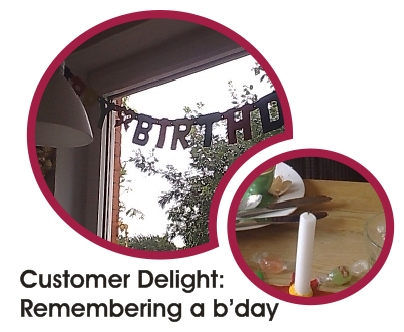
How this quest to experience customer delight started....
My education and work experience has enabled me to travel across 3 continents and at least 10 countries. This has allowed me to experience the delivery of products and services across many cultures and within diverse situations. From the essential "Food, Glorious Food!!!"...and some not so glorious ;) as Oliver Twist would put it to accommodation, through to accommodation and tourist information, I have been on the receiving side of a wide spectrum of products and services, with little to talk about, but the excellent exceptions and the awful, which in retrospect make me smile in a cringing way ;)
I have always kept a mental log of these experiences, and share the corresponding stories to amazed and bewildered people who accompany for some instances in my life-journey.
Funny when examples of your business reading are experience in the real world
It's funny how extraordinary serendipity can sometimes use your daily & mundane experience to provide real-life examples related to the business books you are reading at the time!...the intellectual recipe I was digesting was quite rich: emotional intelligence (audio & reading), Mirror Neurons (which have a social dimension), The Starbucks experience, various papers related to "atmospherics" in virtual & real settings (within the services & retail industries) and two books on innovation from one of the world's best industrial & product design agencies, IDEO: The Ten Faces of Innovation and The art of innovation-Success Through Innovation the IDEO Way.
Take the cuisine experience
When overseas I alway like to evaluate and contrast the restaurant experience with that in the UK, and I try to see how close the experience gets to my ideal restaurant experience. The cuisine experience which I manifested in its full beauty in my mind?...An extreme cuisine experience where the food was the ultimate I ever tasted, the staff the most friendly & gifted when it came to rapport building/emotional intelligence, a setting that could transport me to the food's place of origin, and an atmosphere that would keep me hypnotised until I could not squeeze another morsel through my teeth and which would end with the "sound of the remote pin-machine" awaiting my four digit input!
The "practical reality of my customer delight" experience was to unfold before my very eyes in the real-world before me during my holidays!....wow, what better way to consolidate your understanding of learned concepts while being relaxed and filling up your belly ;)
Germany 1 - England 0 (Experience of Chinese & Indian restaurants)
My wife and had gone to Kassel, Germany for the Famous Documenta 12, the mother of all contemporary art exhibitions, which takes place every five years and had gone on in that city for exactly 60years.
I thought that it would be an excellent time & opportunity to engage my two passions; the arts & to catch up on my business reading: "The Starbucks Experience: 5 Principles for Turning Ordinary Into Extraordinary (by Joseph Michelli)" and Harvard Business Review's September OnPoint (European Edition):...it also provided me with the opportunity to digest "The Ten Faces of Innovation" , specifically chapter 7: the experience architect (pp 165-192). The other nine "faces of innovation" also encompass human qualities & attitudes that for me make the best of leveraging the logical brain's analytical qualities and filtering these through the right-brain's emotional intelligence. Again, very much in-line with the development of emotive products and in-line with my interest in the brain (emotional intelligence & mirror neurons) and its shaping of consumer behaviour.
Focusing on the restaurant experience, I must admit that in the evening I was exposed to some of the best food I have had during my current existence, but what is even more amazing was that only two restaurants got most customer experience factors I have examined, studies and learned about, but only one managed to truly delight me in a memorable way, even though the food was average!..an Indian restaurant & two Chinese restaurants.
The Motel One Experience - Consistent branding with a mile of a smile ;)
Our experience of Motel One gave us another opportunity to experience customer delight...Free WIFI in the Lobby!...and what a lobby!!!
While plenty of the hotels I have been to charge you to the hilt with every little luxury they can, Motel One was refreshing with the fact that you could connect to their WIFI for free at the Lobby. No time limit or anything!...If you wanted WIFI in your room, then you paid for it!...but who wanted to in such a chilled out and wicked lobby anyway?
We were more than Happy to surf the web on our Nokia's check our emails and social networks!
And the rooms?...out of this world and impeccable....just check out the images ;)
All in all, customer delight is about those surprises that are included as part of the services without boasting about it or trying to coerce you in any psychological way. It is that human touch, that detail that makes you smile and want to talk about it, and in turn transforms you into a brand evangelist -a.k.a. a word of mouth recommended fanatic ;) Some of the following reading, research and resources provide some of the elements behind engineering customer delight and experiences (experience marketing):
Ben and Jerry's Double-dip: Lead with Your Values and Make Money Too (Paperback)
by Ben R. Cohen and Jerry Greenfield
Building Great Customer Experiences (Hardcover), by Colin Shaw and John Ivens
Connected Marketing: The Viral, Buzz and Word of Mouth Revolution (Paperback)
by Justin Kirby (Editor) and Paul Marsden (Editor)
Emotion Marketing: The Hallmark Way of Winning Customers for Life by Scott Robinette and Claire Brand (Hardcover - 1 Jan 2001)
Gung Ho!: Turn on the People in Any Organization (One Minute Manager) (Paperback)
by Kenneth H. Blanchard and Sheldon Bowles
Raving Fans: Revolutionary Approach to Customer Service (One Minute Manager) (Paperback)
by Kenneth H. Blanchard and Sheldon Bowles
The DNA of Customer Experience: How Emotions Drive Value by Colin Shaw (Hardcover - 11 May 2007)
Purple Cow: Transform Your Business by Being Remarkable (Paperback) , Seth Godin
99-cows, Seth Godin's- Free eBook- (wordbiz)
Squidoo: Customer Service Psychology (collection of resoruces & links)
The Best-Practice Hamburger: How Wendy's Enhances Performance with its BSC, Harvard Business Review, Digital Download (PDF), 3pp. $ 9.50
The Anatomy of Buzz: How to Create Word of Mouth Marketing (Paperback) by Emanuel Rosen
The Art of Innovation: Success Through Innovation the IDEO Way by Thomas Kelley (Paperback - 4 Mar 2002)
The Secrets of Word-of-Mouth Marketing: How to Trigger Exponential Sales Through Runaway Word-of-Mouth: How to Trigger Exponential Sales Through Runaway Word of Mouth (Paperback) by Silverman
The Starbucks Experience: 5 Principles for Turning Ordinary Into Extraordinary: 5 Principles for Turning Ordinary into Extraordinary (Hardcover), by Joseph Michelli
The Ten Faces of Innovation: Strategies for Heightening Creativity by Tom Kelley and Jonathan Littman (Paperback - 3 Aug 2006)
Measuring customer satisfaction in the fast food industry: a cross-national approach, G. Ronald Gilbert, Cleopatra Veloutsou, Mark M.H. Goode, Luiz Moutinho, Journal of Services Marketing, ISSN: 0887-6045, volume: 18, Issue: 5, Page: 371 - 383, 2004 (available digital download via emerald insight) - £14.50
Fresh business thinking: Fast Company (magazine, US), with search-able digital archive
More Fresh business thinking: Business 2.0 (magazine, US), with search-able digital archive
Explore and learn about: Neuroeconomics, which combines neuroscience, economics, and psychology to study how we make choices. check out Neuroeconmics in Wikipedia, or another of my articles that looks at emotion & choice, and has further interesting references.
 Logical consumer & current buying behaviour school of thought...selling us short?
The current textbook approach to consumer purchasing behaviour and the corresponding purchasing process may be providing an inaccurate picture.
Researchers have been deploying functional magnetic resonance imaging (fMRI) with interview elicitation techniques to: monitor, visually represent and match brain activity to how humans manage decisions. These decisions are framed in the short & long term and these have been shown to be tied to conscious and unconscious thinking...to arrive at a purchasing decision.
Distinction of conscious & unconscious thinking within the buying process...minus the philosophy
Thinking about buying a new car while directing attention at potential candidates and their attributes is said to constitute conscious thought.
Take the same scenario, but this time Thinking about buying a new car while your attention may be engaged during various intervals at other things or activities has been cited to be unconscious thought.
[Ap Dijksterhuis, 2006]
Experiments & Quantitative research: demonstrates a significant relationship between the conscious and unconscious
Research experiments with students demonstrated that within certain products conscious thinking was the dominating mode for some, while for other products it was unconscious.
Products where conscious thinking dominated in the experiments...
conscious thinking as the most dominating mode of thinking when it came to buying:
- Toothpaste
- Shampoo
- a CD
- Shoes
Unconscious thinking as the most dominating mode of thinking when it came to buying:
- Airline Ticket
- Camera
- Hotel room
- Car
Neuro research is examining the symbiosis between our rational & irrational behaviour by linking in "time" into the buying & decision making process and highlighting how "time makes us behave inconsistently"...due to the perceived risks, rewards and our in-built loss-aversion.
Our hard-wired fear of loss and personality adds the complexity of emotion and personality-type to the mix...
Researchers set up experiments where scenarios of loss could be created, such as winning & losing money. Rsearchers discovered that the subjective, negative feeling of loss was much more
intense for people than the buzz gained by winning. Other researdch andstudies suggest that losses may have twice the psychological impact of equivalent gains (Schwartz, 2004). Add to this mix, the personality element (satisficer - happy with what you can get, and maximizer, a perfectionist who only wants the best). Therefore the fear of loss as a result of a wrong decision may be abhored and felt more my maximizers than satisficers....hence the term "loss aversion."
[Barry Schwartz is the Author of "The Paradox of Choice - Why more is less - Winner of BusinessWeek's top ten book of the Year ]
According to Harvard University's David Laibson, Professor of Economics, we can be trapped by our primitive brain when it comes to the issue of consumption or to delay its gratification (an appeal to the hedonic part of our makeup?). We therefore tend to behave primitively...like a chimp after his banana. Laibson coined "quasi-hyperbolic discounting" to describe the behavior. The link intervention and between our Dr. Jeckel & Mr. Hyde part of our brains in terms of primitive (linked to instinct, survival and primordial needs), conscious-logical and the resulting behaviour in an economic setting (resulting in a choice & corresponding decision) is being examined and explored by what has been coined as "Neuroeconomics".
Smart companies are engineering "emotion" eliciting & engaging products & services
Donald Norman, Cognitive Science professor at the University of California, and author of the books "The Psychology of Design", and "Emotional Design", has examined our tribal and historical relationship with objects & artifacts throughout our millennia. By bringing the elements of beauty, aesthetics and design into products companies are tapping into the subconscious and emotional part of the brain. Thus they are able to move gravitate away from the commoditization of goods (in a hyper-competitive market space). Products have become "experiential" through sleek contours and functional tactile materials that evoke thoughts and emotions. The Japanese have been doing it for years in the car market, by going down to the level of the sound a car-door makes when closing, to how the headlights & grill should be interpreted as an abstract character: smiling, friendly, etc...And this has been extended from the high end to the "affordable elements of products"...the engineered "cuteness" embedded into these lower-cost products (that appeal to our emotions). These are known as "Cutensils" (Time article: The redesigning of America)...also check out this article on cute plastic objects.
Conclusion
By engineering characteristics into products and services that bring a smile to our face on top of the expected level of quality & functionality, we are able to deliver greater experiences to our prospective customers...thus turning customer wow's into customer wows!
...but eliciting the subconscious perceptions a customer has about an existing product or services in order to map these and hence build an engaging and persuasive purchasing experience is a challenge which current market research techniques fall short on!
Useful reading & references
How Customers Think: Essential Insights into the Mind of the Market (Hardcover)
by Gerald Zaltman (amazon associates - TinyURL)
Emotional Design: Why We Love (or Hate) Everyday Things (Paperback)
by Donald A. Norman (amazon associates - TinyURL)
The Design of Everyday Things (Paperback) by Donald A. Norman
(amazon associates - TinyURL)
Emotion and Adaptation (Paperback) by Richard S. Lazarus
"Emotions play a central role in the significant events of out lives ..."
(amazon associates - TinyURL)
The Paradox of Choice: Why More Is Less (Paperback) by Barry Schwartz
(amazon associates - TinyURL)
Why Logic Often Takes A Backseat
The study of neuroeconomics may topple the notion of rational decision-making
http://www.businessweek.com/print/magazine/content/05_13/b3926099_mz057.htm?chan=mz&
Mind Reading
The new science of decision making. It's not as rational as you think
http://www.msnbc.msn.com/id/5304846/site/newsweek/
Neuroeconomics: How Neuroscience Can Inform Economics
http://www.neuro-economics.org/media/Papers/JELfinal.pdf
The Hidden Economy of Esteem
http://www.hss.caltech.edu/%7Esteve/leary.pdf
On Making the Right Choice: The Deliberation-Without-Attention Effect
Ap Dijksterhuis, et al. Science 311, 1005 (2006); DOI: 10.1126/science.1121629
(multiple product choice illustration based on this article)
http://www.hss.caltech.edu/%7Esteve/rightchoice.pdf
Neuro-science primer
http://neuroeconomics-summerschool.stanford.edu/pdf/GlimcherNeuroscience.pdf
FMri Primer for congnitive neuroscientists
http://neuroeconomics-summerschool.stanford.edu/pdf/ODoherty_fMRI.pdf
Observations: Consumers as On-going eCommerce Platform/Service co-developers
0 comments Posted by William Doust at 03:34
Background & Collaborative consumer profile
Executive Summary
Firm controlled affiliate program platforms have been developed to varying degrees of sophistication. For example Amazon's affiliate program is quite robust and supportive. It cleverly enables amazon and firms alike to play to particular consumers' second-life styles in the digital realm. Firms' eMarketers are fully aware of how consumers' influence and participation on the web involves opinion and/or consumer generated media via web2.0 (Wiki O'reilly) platforms, and therefore how to leverage this behaviour towards their sales efforts.
For those who dabble in affiliate programmes, the amazon affiliate back-end infrastructure speaks volumes with regards to how well the means of producing a mutual benefit has been identified, designed, planned, and integrated within the corresponding eCommerce platform.
...But mechanisms for providing feedback on the very collaborative eCommerce platforms/Service are still at very primitive stages. This is very, very good news as it spells out: opportunity.
Under-developed feedback platform for Collaborative eCommerce platform Co-creation Space Available...
Firms that seize underdeveloped primitive feedback mechanisms co-develop these platforms with their customers in a mutually beneficial manner will be in a competitive position to optimize their eCommerce activities.
Therefore co-creation and that motivates and spells out benefits are likely to increase their impact on the bottom line.
The pieces of the puzzle are there, and the beauty is that we can re-purpose and re-contextualize robust methodologies and procedures from various disciplines such as:
>Anthropology
>production design & development, their corresponding interaction design disciplines
>psychology (behaviour-motivation)
>Software Development
>Human Resources
Consumers want a piece of the action and are rolling their sleeves to shape the web...
Consumers are no longer passive cash-cows to be milked till the bulls come home. Thanks to broadband's facilitation of rich web platforms, consumers have been empowered to collaborate in shaping the new web in many ways. To increase sales, increase awareness and decrease the likelihood of failure (in commercial cases, product/service), smart firms have latched onto the behaviour of prolific citizen journalists /"mini-preneurs", and consumer evangelists. The move toward brining in customers as both partners and consumers started way, way before the citizen journalism buzz-word did the rounds. And this was possible thanks to firms' development of collaborative tools. By appealing to consumers' newtworks of interests, their network of influences and by ensuring that their customers' kudos could be put on steroids, firms have ensured that consumers have come on board. As unpaid sales-forces, collaborators and co-developers; consumers are helping the bottom line in the following common ways:
>Virtual Sales forces - commission based (affiliate programmes - amazon)
>Self Publishers - cost plus percentage (Books, Calendars, Prints, CDs, DVDs)>
>Micro Design Boutique owners - cost plus percentage (Bags, T-shirts, Polo's, bibs, underwear, etc.)
>Shop Aggregators - commission (amazon)
>Ad Sponsored consumer generated content - bloggers, personal websites
>Human filters & human robots (tagging, reviews -folksonomy)
>Web Advocacy & participants - interest groups, grid-computing (web-based)
>Web Philanthropists - Virtual Volunteering
But Many eCommerce organization are still missing a collaborative trick...
Providing clear incentive programs for consumers to further the development of the very collaborative eCommerce platforms which firms utilize to engage their consumers and enhance their bottom lines is an area that requires much attention.
Consumers as Innovators: From Specialist Experts to Consumer Experts
Peer-production within the web as a means of driving innovation has been going on for quite a while within the software industry. Movements such as open-source have ensured the democratization of the tools of production and business, only formally available to the elite and deep pocketed.
Putting aside the philosophical motivations,world views, and challenges to the various industries, what is of interest here is the robustness of the collaboration process.
If firms could harness collaboration for the development of their eCommerce platforms in a structured and robust way that motivated and incentivated collaborators, then Innovation could perhaps move much faster.
Collaboration Personas & what they could bring to the table
Being on the receiving end of continuous product & service offers and their corresponding interactions have made many consumers experts in their own rights. We all have in our lives and within our network of influencers - individuals who can enlighten us about products or services in many ways...
Take those wonderful "recommenders" in the real world...
...their area of expertise seems to be always spot-on, even when they come with their caveats!
...Whether it's that wonderful pizzeria where you should only stick to the gorgeous thin-based crispy pizza experience, followed by a coffee or dessert - elsewhere (because the pizzeria doesn't have strength in that department), or that cut-prize electronic store that has every gadget imaginable, but whose price tag comes with moody service...
...What about the graceful moaners?
This bunch have many times made admirable observations and highlighted insights that have made us nod in acknowledgment, you must know some?
...such as a colleague who once mentioned, "why doesn't my online banking account have a big clear button that says "log-out" or "log-off"...that would make me feel more secure...
or
..."Why am I left to struggle on web-forms with no visible cues or means to gain some assistance except by getting on a phone..."
Participatory fruitfulness for the development of eCommerce collaboration platforms?
Sophisticated and robust eCommerce collaboration platforms & programs have been mainly oriented towards the aggregation of opinion, and expertise, to narrow to two main areas. The dominating rewards for contributors are either psychological, in terms of reputation rewards, or mutually beneficial by driving interest to the author's affiliate related content (provided by the same supplier, who also benefits from this free labour). Positive reputation has been deployed as a motivator and catalyst. This has been well thought out; the means of producing a mutual benefit has been identified, designed, planned, and integrated within the corresponding eCommerce platform.
...But feedback and collaboration on eCommerce platform development currently appears to encompass an asymmetrical relationship - with the benefits being stacked-up on the side of the firm. Trawling through google, form based feedback appeared to be the norm with rewards such as T-shirts and free software beyond the beta phaze.
The author would like to invite others to trawl through Google to identify robust consumer/customer feedback programs that engage and apply innovations from their very consumers.
The amazon.co.uk experience
My experience of amazon.co.uk as an affiliate is amazingly rich. But a clear visual cue regarding feedback was text based and this took you to a form. The Associate blog had posts referring to feedback on specific updates on the portfolio of associate tools. The forums are generally an exchange between users.
The Etsy.com experience
Etsy is like the "ebay" for people specifically involved in arts & crafts. Again, amazing tools but no robust feedback mechanism as described here was identified.
Conclusion
The membrane between the customer and the organization is being changed thanks to what we have observed. And organisations such as lego are taking full advantage and embracing customers as product co-creators...but again there is opportunity at developing the very eCommerce platforms via robust eFeedback processes and procedures.
Related Content & references...
Innovation Briefing: customer centred innovation
http://www.innovaro.com/inno_updates/Innovation%20Briefing%2009-06.pdf
Activity in human reward-sensitive brain areas is strongly context dependent
http://web.uvic.ca/psyc/braincoglab/2005_NieuwenhuisHeslenFeldEtAl2005.pdf
Evolution of the New Economy Business Model
William Lazonick, UMass Lowell and INSEAD, william.lazonick@insead.edu
http://www.uml.edu/centers/CIC/Lazonick%20NEBM%20October%202005.pdf
The Impact of the Internet on Business Model Evolution within the News and Music Sectors
http://www.insyl.unisa.edu.au/publications/theses-papers/Krueger.pdf
Business model design & evolution
http://jucmnav.softwareengineering.ca/twiki/bin/viewfile/UCM/VirLibIamot05?rev=1.1;filename=IAMOT05.pdf
The New Darwinism
Corporate survival demands synchronized business and IT changes
http://www.optimizemag.com/disciplines/business-management/showArticle.jhtml?articleID=17700693
Customers as Innovators: A New Way to Create Value (HBR OnPoint Enhanced Edition)
http://harvardbusinessonline.hbsp.harvard.edu/b01/en/common/item_detail.jhtml?id=9640
check out Open Source models of working...
http://portal.acm.org/citation.cfm?id=512035.512055
The Ying-Yang of Web interactions: Impact, emotion, mood & previous experience
1 comments Posted by William Doust at 17:00Executive Summary
Efficient trouble free website interactions and transactions have been shown to have psychological/emotional impact on prospective customers' cognition, brand recall, and brand association. What eCommerce websites cannot control though is where within the portfolio of consumer choices the firm falls. The consumers initial emotional mind-set prior to their entering an evaluation process is also outside the control of eMarketers and the eCommerce site at the initial stage. This means that the product/service to be purchased will be influenced by the frame of mind and hence be totally dependent on how the mood derived from these emotions affect and the decision making process itself.
Barry Schwartz (in The Paradox of Choice, Why more is less) cites the growing stress of consumer decision making within the current scenario of an ever growing multiplicity of choice. The consumer has to face and factor the growth of time invested in assessing product/service alternatives. Areas of activity such as corresponding trade-offs and their associated opportunity cost have to be taken into account within the constrains of our genetically in-built "loss aversion" behavioral response. Our psychological wiring therefore helps us cope better with gains rather than with losses. An implication of current consumer choices is that complexity of the purchasing process is growing and correspondingly the degree of involvement within the purchasing process and its associated emotional investment. Research has again demonstrated that these very factors affect the quality of evaluation and decisions themselves (pp. 131).
Negative States of emotion and the consumer purchasing & decision making process
Negative emotional states are said to narrow the decision making focus. Instead of examining all the contributing factors only a few will be considered at times ignoring aspects that would be pivotal to the final decision. The impact of a situation, event or interaction which renders a negative state of mind is known to have an impact on visual memory & its recall. The symptoms of a negative frame of mind creates tunnel vision (affecting peripheral vision), and can interrupt the natural flow and performance of established tasks. This is one of the reasons that the practice of drills are set-up, as drills serve as rehearsals that will condition our behaviour over time in case of emergency, where are frame of mind would not allow us to act rationally and within our full faculties. Drills are carried out regularly to socialize us within the context and cues derived from these rehearsed situations.
Positive states of emotion and the consumer purchasing & decision making process
A positive frame of mind has been shown to have the completely opposite impact enhancing creativity and opening up avenues of thought which would not even materialize under a negative state of mind. Therefore consumers are more likely to make decisions that are in their best interests within a positive state of mind.
Frames of mind: impact on eCommerce pole-position & decision making
But as marketers we cannot determine the frame of mind our prospective customers will bring to our eCommerce websites, let alone what position we hold within the customers' decision making process.
Under such circumstances it may be beneficial to translate and map our understanding of the impact of consumers' frames of mind onto the site's persuasive architecture elements and corresponding eMarketer controlled factors (functional, psychological, and content related). The symbiotic relationship of these factors should provide an indication on the degree of engagement, consumers' cognition and the overall efficacy of the consumer's web-experience - as designed and controlled by the firm. Indeed given the strong uncertainty of the consumers' "emotional-frame-of-arrival" at an eCommerce site it would be wise to adopt a "reactio-nary" framework from the consumer perspective as a counter perspective to the designed web-experience. This can be approached in terms of Visceral (perceptually-induced), Behavioural (expectation-induced), and Reflective (intellectually induced). The proposition of this consumer reaction-ary perspective has been borrowed from "product design", specifically showcased by Norman D. A. author of "The design of everyday things", re-issued as The psychology of everyday things, and "Emotional Design: Why We Love (or Hate) Everyday Things".
The overall understanding of the web experience and its definition has been described as:
"...the consumer’s total impression about the online company (Watchfire Whitepaper Series, 2000) resulting from his/her exposure to a combination of virtual marketing tools . . .under the marketer’s direct control, likely to influence the buying behavior of the online consumer (Constantinides, 2002, p. 60). The virtual customer’s total impression and actions are influenced by design, events, emotions, atmosphere and other elements experienced during interaction with a given web-site, elements meant to induce customer goodwill and affect the final outcome of the online interaction."
[Constantinides, Internet Research, Volume 14 • Number 2 • 2004, pp. 112
Emerald Group Publishing Limited, ISSN 1066-2243]
The Ying-Yang of Web interactions at Lufthansa's eCommerce site an A-typical Experience
The research as far as I have been able to uncover has not actually covered my A-typical experience, which I wonder how many others have faced.
The particular A-typical and unique circumstances are that the consumer has identified the preferred supplier and wants to purchase their goods/services even though functionally the site has created barriers, transactional dead-ends (form related) and limitations due to the mismatch of the consumer's preferred choice of browser and the firm's functional support for a preferred set of browsers.
Some persistent customers will bite the bullet like I did...Why? Because Lufthansa had the cheapest deal I could get based on the hours of research I had invested and my usual truck-load of associated travel requirements, constraints and trade-offs. Instead of three simple steps, I was put through the paces and forced to become involved in ten, as the following adventure illustrates:
(1) Search Transaction
(2) Form Processing
(3) Browser dead end/error
(4) Browser refresh reaction (conditioned)
(5) Browser Switch - Firefox-to-IE
(6) Recall/Refer to flight search details as in (1)
(7) Anger/resentment tipping point (think about cheap flight mantra!)
(8) Re-start Search again as in (1)
(9) Process forms/credit card - await results
(10) Completed Transaction/Confirmation
Lufthansa's eBusiness team could have tested the flight booking process across multiple browsers. But as an outsider I'm not aware whether Lufthansa deemed that the trade-off relating to the associated costs of ensuring compatibility with Firefox far outweighed the potential revenue from prospective customers using Firefox. If this was the case, a simple visual sign-post could alert potential Firefox users that the site's web-forms do not support Firefox.
Jumping through these hoops and functional limitations I had to overcome in order to get hold of my ticket, inspired me to turn this experience into a visual representation which I have termed the Ying-Yang of emotion while browser switching during an eCommerce transaction. Will your company ensure that you do not build negative word of mouth by ensuring that you build a positive website experience?
Conclusion and implications
Standard practice can be applied in addressing the usual eCommmerce short-comings. These generally accepted bread-and-butter building blocks of eCommerce that can pre-empt patchy or poor web experiences including but not limited to: Functional, Psychological.
Within the functional aspect for example, cross-browser testing usually avoids many eCommerce transactional related challenges. But limiting activities to the usual suspects does not address how the human mind, emotion, cognition and decision all blend into a thick broth of complexity.
Here lies the opportunity that research, psychology and understanding of the workings of the human brain can bring bottom line benefits currently addressed by very few.
Research has shown that decision making within the purchasing process is not as completely rational as it was once thought to have been. I have substantiated the impact of emotion and the mood it creates and its knock-on effect on the process of evaluation and decision making. Accordingly consumer surveys and research that attempt to address consumer purchasing intent and satisfaction without addressing the emotional side of purchasing will sell itself short. Gerald Zaltman (How Customers think) has developed a methodology of methodology that facilitates the elicitation process of unconscious emotional cues and perceptions that shape consumer purchasing intent and experiences.
In addition customer profiling needs to embrace the influential and corresponding impact of emotion and mood within the decision making process. There are a multitude of wholly rational means of profiling customers and their related behaviour. Fortunately I have discovered through my reading and research that Mr. Schwartz's (The Paradox of Choice - Why more is less) has cited attractive, compelling and relevant emotion related profiles that fit within the aforementioned paradigm of consumer decision making. These consumer profiles were identified as being Maximizers and Satisficers. The former group usually have a deep degree of involvement and emotionally invest quite heavily as maximizers are seen to be perfectionists - who only settle for what they perceive and are influenced to perceive is the best choice. Consequently when the wrong choice is made they are said to be the ones who suffer the most and have an inability of letting go of the associated emotions. Satisficers can be summed up as pragmatists who will make a purchase decision based on various constraints without obsessing over things. Consequently they are likely to get over wrong choice much more easily than Maximizers.
Useful & Recommended Reading (amazon-through tinyurl)
Barry Schwartz (2005), The Paradox of Choice, Why more is less
Donald A. Norman (2002). The design of everyday things. The re-issue, with a new preface, was apparently re-titled The psychology of everyday things.
Donald A. Norman (2004). Emotional Design: Why We Love (or Hate) Everyday Things.
Gerald Zaltman (2003), How Customers Think: Essential Insights into the Mind of the Market
Lazarus, R. S. (1994). Emotion and adaptation.
Related Research
Constantinides, E. (2004), "Influencing the online consumer’s behavior: the Web experience", Internet Research, Volume 14 • Number 2, pp. 112, Emerald Group Publishing Limited, ISSN 1066-2243.
Constantinides, E (2002), “The 4S Web-marketing mix model,e-commerce research and applications”, Elsevier Science,Vol. 1 No. 1, pp. 57-76.
Dennis, C., Harris, I. and Sandhu, B. (2002), “From bricks to clicks: understanding the e-consumer”, Qualitative Marketing Research, Vol. 5 No. 4, pp. 281-90.
ESSLER, U and WHITAKER, R. (2001), "Re-thinking E-commerce Business Modelling in Terms of Interactivity", Electronic Markets Volume 11 (1): 10-16.
Fogg, B.G., Soohoo, C., Danielson, D., Marable, L., Stanford, J. and Tauber, E. (2002), “How do people evaluate a Web site’s credibility? Results from a large study”, Persuasive Technology Lab, Stanford University, available at:
www.consumerwebwatch.org/news/report3_credibilityresearch/stanfordPTL_TOC.htm
Grabner-Krauter, S. and Kaluscha, A.E. (2003), “Empirical research in online trust: a review and critical assessment”, International Journal of Human-Computer Studies, Vol. 58 No. 6, pp. 783-812.
Interactive Bureau (IAB) (2003), “FTSE-100’s Web sites are still ‘wallowing in mediocrity’”, available at: www.iablondon.com/news/news.cfm?newsID=150
Koufaris, M., Kambil, A. and LaBarbera, A. (2002), “Consumer behavior in Web-based commerce: an empirical study”,International Journal of Electronic Commerce, Vol. 6 No. 2,pp. 115-38.
Lee, P-M. (2002), “Behavioral model of online purchasers in e-commerce environment”, Electronic Commerce Research, Vol. 2, pp. 75-85.
Liang, T.-P. and Lai, H.-J. (2002), “Effect of store design on consumer purchases: an empirical study of online bookstores”, Information & Management, Vol. 39, pp. 431-44.
Lightner, N.J. and Eastman, C. (2002), “User preference for product information in remote purchase environments”,Journal of Electronic Commerce Research, Vol. 3 No. 3,pp. 174-86.
Loebbecke, C. (2003), “E-business trust concepts based on seals and insurance solutions”, Information Systems and E-Business Management, Vol. 1 No. 1, pp. 55-72.
McKnight, D.H., Choudhury, V. and Kacmar, C. (2002), “The impact of initial consumer trust on intentions to transact with a Web site: a trust-building model”, The Journal of Strategic Information Systems, Vol. 11 No. 3-4, pp. 297-323.
Nantel, J.-HEC Montréal, Sénécal, S.-HEC Montréal and Berrada, A. M.-HEC Montréal (2005), "THE INFLUENCE OF « DEAD-ENDS » ON PERCEIVED WEBSITE USABILITY", Cahier de recherche N° 05-08-02, ISSN : 1714-6194.
Scheffelmaieer, G., Vinsonhaler, J., and Paper, D. (2004), "Purchase Time and User Satisfaction as Effected by Website Convenience", Issues in Information Systems, Volume V, No 1, 294-300
Silverman, B.G, Mintu Bachann,M., Al-Akharas,K., Dept. of Systems Engineering, University of Pennsylvania (2001), "Implications of Buyer Decision Theory for Design of eCommerce Websites". Possibly working paper as found on the web and no reference was made to a journal.
Vrechopoulos, A., O’Keefe, R.M. and Doukidis, G.I. (2000),“Virtual store atmosphere in Internet retailing”, Proceedings of the 13th International Bled Electronic Commerce Conference, Bled, Slovenia, 19-21 June.
Wikstrom, S., Carlell, C. and Frostling-Henningsson, M. (2002),“From real world to mirror world representation”, Journal of Business Research, Vol. 55 No. 8, pp. 647-54.
Wong, A., "The role of emotional satisfaction in service encounters", Managing Service Quality Volume 14 · Number 5 · 2004 · pp. 365–376, Emerald Group Publishing Limited · ISSN 0960-4529.
Advertising striking out?... TV, web-banners & now outdoor Advertising?
0 comments Posted by William Doust at 09:22A fortnight ago, Monday’s Media Guardian (25.06.07) carried a special supplement on “outdoor media” with a subtitle, “Digital Vs Poster – The transformation of Outside Advertising”.
According to this supplement, the vitality of the outdoor advertising echo-system is allegedly being fuelled by several factors such as:
- the number of individuals spending more time out-door during the day has increased over 51% over the last 10years (Belinda Archer)
- the fragmentation of television audiences (Catlin Ftizsimmons) and,
- the integration digital & mobile enabled technologies to create more engaging and interactive experiences (Catlin Ftizsimmons)
Although the face of advertising has changed over the decades, the general mind-set of the advertising industry remains the same: “interruption based advertising”.

There was no editorial with regards to consumers’ lifestyles, long working hours, work pressure, fatigue and the work-life balance, and how these have an impact on energy levels and attention.
The experience of sitting in an underground train, be it in New York City, London, or Caracas (Venezuela) is no different from any other. How many “zombies” have you seen sitting either plugged into their music-systems, reading, dozing off, or simply on “standby” waiting for their particular stop? How would you divided the ecology of an “underground wagon”, and the relationship to a potentially attentive advertising audience?…I have had first hand experience, and it’s amazing to see the similarities.
Now fit advertising within this consumer centred life-work context and the fact that according to sources we are exposed to between 1500-10,000 a day, and what do you think is going to happen to attention and recall?
That’s not all though. Continuing a little longer with human factors, advertisements have become messengers to a new phenomenon, too much choice, which according to “Barry Schwartz”, author of “The Paradox of Choice, Why more is less", is creating a lot of stress within the decision making process – that ultimately is to culminate in a purchase. Evidence can be seen on British TV advertisements of website aggregators / comparison websites that have sprung-up to assist prospective consumers with making a final choice.
In this environment where creative meets technological advertisement delivery vehicles, and channel integration, the following observations made on new products and services will definite ring true within advertising: “To exploit new opportunities, managers must know significantly more than they currently do about how customers think and act”
(source: speech delivered to the marketing science institute, Boston MA, 25 April 2002, by George S. Day, The Geoffrey T. Boisi Professor of Marketing and the director of the Mack Center for the Management of Technological Innovation at the Wharton School of the University of Pennsylvania).
To increase advertising effectiveness, the industry will have to put the consumer at the centre of the experience by appealing to their values, reward systems, and the way the brain is wired.
If the advertising industry does not get its act right with regards to understanding how consumers are wired, then 80% of the new product offerings will continue to fail. The persistence of market research with the use of tools such as focus groups that continue to dig into consumer opinion by appealing to the conscious and rational part of the brain, which only forms part of 5% of our cognition, will continue to waste vast amounts of resources. The other 95% of the unconscious part of the brain is where real insight can be gathered about how customers really think, according to Gerald Zaltman, Professor of Marketing at Harvard Business School, Fellow at Harvard University’s interdisciplinary Mind, Brain, Behaviour initiative, and co-founder of the research consultancy Olson Zaltman Associates. His customers include: coca-cola, Microsoft, Bank of America, Motorola, Procter & Gamble and IBM. And these insights can be seen in his book tilted, “how customers think, Essential Insights into the mind of the market”.
“Something’s in the air”, whether it be on broadcast or on WIFI, consumers have embraced technologies to block advertising. Will the advertising industry wait for the two ad-blocked channels/mediums to transform into the three apocalyptic ad-blocking channels/mediums?...will the industry strike out three times?
The bell has tolled already with ad-blocking technologies such as the first incarnations of TiVo, as a forewarning that consumers will embrace technologies to block annoying ads. It has tolled for the second time with ad-blocking technologies and software (explored within a paper which is available on request from Tracy Osterle a colleague at my former employer TechnoPhobia) on the web. Will this resistance come to outside media for the third?
There are two active social movements whose remit is to deride and undermine corporate advertising: Adbusters, and Space Hijackers.
Adbusters tackles advertising with spoofs that undermine the advertisers’ claims and uncovers either “corporate skeletons from their closets” or highlights health/environmental issues related to the brand and the product/service. Space Hijackers have been described as “…a group of urban high jinksers using extremely creative methods to reclaim some public spaces from corporate noise…” (source: Computer Arts Projects Issue 99. pp. 29-32). Clashes have been documented, including corporate advertising incursions into fake “Urban street Style” advertising.
To conclude, it is un-arguable that advertising outdoors will continue to obtain what the industry deems as reasonable results and ROI. The interruption-based advertising paradigm can’t let go of clever memorable advertising as exposed by agencies such as Fallon, the branding and campaign advertising agency, which has created good ROI for its clients. But this approach will continue to delivery bottom line peaks and troughs, which are producing marginal results. And who knows we may even go too far, such as the invasiveness showcased by the New York Times article, “Anywhere the Eye Can See, It’s Likely to See an Ad”, January 15, 2007 (By Louise Story). From advertising on eggs to “small Big Mac burgers flying past; when people stepped on the Ad, the burgers bounced away from their feet”. And elsewhere advertising is being put on flocks of sheep, and sinking all the way to the bottom with “Ass-vertisement”…